Slo.ppt
See also: poopdecks, PowerSlop
Slo.ppt is a poor quality slide deck generated with AI. Symptoms include lack of cohesive story and too much text. Audience members may feel like they are reading a document pasted over several slides.
Bad slide decks have existed for as long as slide decks. We can’t blame AI for that. But now it is much easier to carelessly create them. It seems like an efficiency gain. Feed in some markdown, get a 30+ slide deck you can present. But public speaking is a high leverage activity. You may have 10, 100 or more people listening. You are probably underinvesting in your talk preparation.
There used to be friction in creating slides. You had to think about what you want. Each text box, each graphic, took effort. It was a limiting function (even if not always successful). You’d iterate, and the slides would evolve as your talk did. Now that friction has gone.
Today with AI, it’s effortless to create a presentation for your talk. Feed in your knowledge base, and ask for a deck. At first glance, these decks look great! Clean aesthetics, full of detail and supporting speaker notes. It would take me hours to create something that looks worse. But it’s a trap.
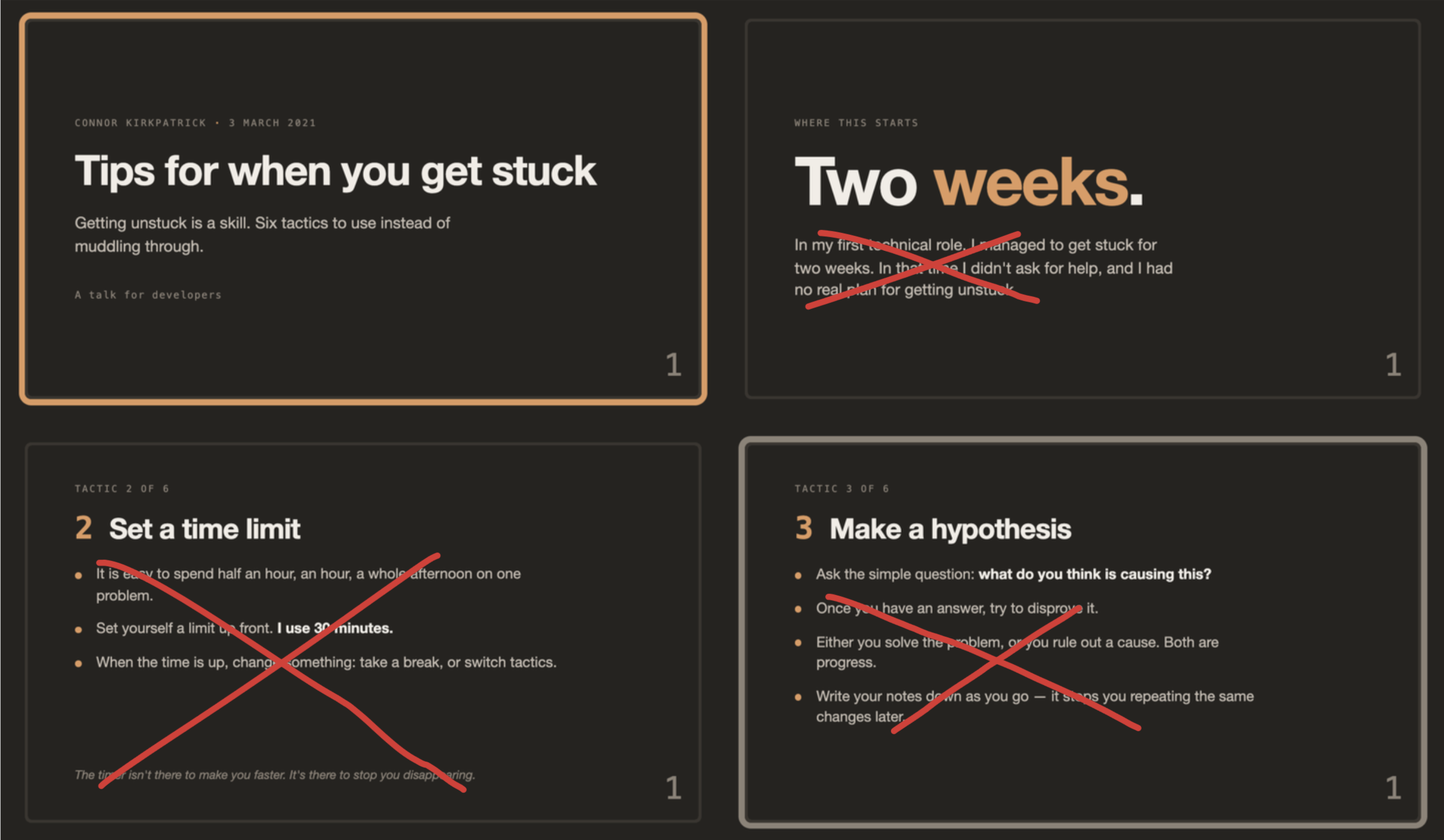
Here’s a presentation I created with Claude from one of my blog posts. Everything crossed out should be said, not written.
Slides exist to support your story. Otherwise you would be sharing a document. Regardless of how charismatic you are, pasting the wall behind you with hard to read text has the equivalent effect to putting earmuffs on your audience and dimming the lights. Your slides should have the minimal amount of content required to support your story. Slo.ppt has the tendancy to invert the speaker/slides relationship, causing the speaker to talk to their slides.
So what should you do instead?
- Have an initial story written alongside the detailed notes. Specify what should each slide represent.
- Specify minimal text. Move text to speaker notes if you need a hint.
- Play with shrinking the margin and padding. What’s readable on your laptop can be tiny on a project screen.
A good presentation is a story. But who’s story is it? Better steering can help, but ultimately, the user needs to know their story, not delegate it. Otherwise you’re a more theatrical version of a meat proxy.